
By design, most momentum investing strategies trade once a month. Short-term market movements are often little more than noise, and attempting to capture every market up and down can be a futile exercise—at least for systematic investment strategies.
That said, some successful trading strategies are specifically designed to capture short-term movements. Mean-reversion strategies, for example, seek to profit from a return towards a longer-term average following an extreme short-term move. Swing-trading strategies, meanwhile, are designed to capitalise on shorter-term market movements.
At fundalytix, most of our strategies follow a monthly rhythm. We evaluate markets and execute trades using a systematic, rule-based approach, with clearly defined criteria for entering and exiting positions. Our strategies are designed and extensively backtested, with the objective of delivering superior risk-adjusted performance relative to their respective benchmarks.
From time to time, clients ask us a simple question: if a strategy works when rebalanced once a month, why not trade it twice a month, weekly, or even daily?
Our analytical mindset was intrigued by the question, so we decided to test it.
Putting More Frequent Trading to the Test
We created a universe of portfolios, each consisting of a randomly selected number of our momentum investing strategies, with each strategy equally weighted. We then backtested these portfolios using four different trading frequencies: monthly, semi-monthly, weekly and daily, both with and without transaction costs.
The conclusion was clear: increasing the trading frequency of strategies designed around a monthly investment rhythm did not improve performance. In our backtests, it actually reduced it.
We first looked at the results without transaction costs. These results are not conclusive measures of real-world performance because they exclude an important component of investing, transaction costs. They are nevertheless useful for isolating the effect of trading frequency itself and comparing gross and net results.
Ignoring Transaction Costs
| Trading Frequency | Annual Return | Max Drawdown |
| Daily | -0.62% | -0.80% |
| Weekly | -0.52% | -0.60% |
| Semi-Monthly | -0.28% | -0.60% |
Even before accounting for transaction costs, more frequent trading reduced performance.
We initially expected more frequent trading to potentially improve maximum drawdown by allowing the portfolio to respond more quickly to changing market conditions. Yet even on this measure, the results did not improve.
Adding Transaction Costs
The picture becomes even clearer once transaction costs are included. Assuming a transaction cost of 0.1% per trade:
| Trading Frequency | Annual Return | Max Drawdown |
| Daily | -2.87% | -2.60% |
| Weekly | -1.15% | -0.90% |
| Semi-Monthly | -0.54% | -0.70% |
Adding transaction costs produces a significantly more negative result, particularly at higher trading frequencies. Daily trading, for example, reduces annual performance by almost 3%.
The message is straightforward: trading a monthly strategy more frequently does not necessarily make it more responsive or more effective. Instead, it can add trading costs and execution noise without delivering a corresponding performance benefit.
Monthly Signals Don’t Mean You Have to Trade on One Day
Most Tactical Asset Allocation and Momentum Investing strategies are deliberately built around a monthly rhythm. Increasing the frequency of their signals or rebalancing does not necessarily add value. In our backtests, it actually reduced performance.
However, there is an important distinction between how often a strategy generates investment decisions and how an investor chooses to execute those decisions.
For clients who prefer to spread their execution across several days—for example, because they manage a large portfolio and want to reduce potential market impact or slippage—we offer two approaches.
- Stagger the strategies
We can spread the portfolio across multiple strategies and execute the monthly rebalance of each strategy on different days throughout the month.
The investment decisions remain monthly, but the execution is diversified across time. This can help reduce the risk associated with any single execution date—essentially reducing the element of “timing luck” that comes with placing all trades on one particular day. - Tranche the portfolio
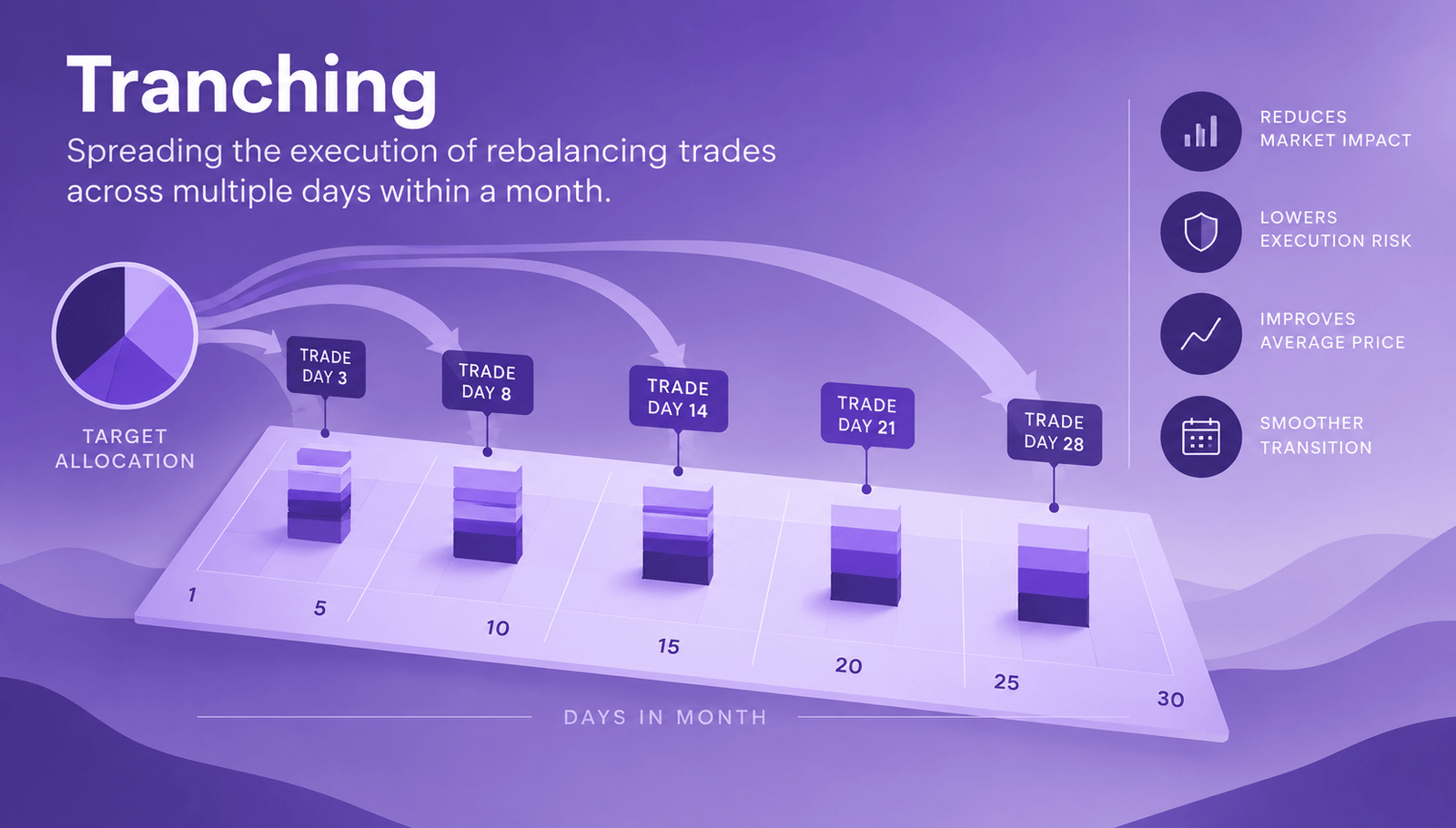
Alternatively, we can split the execution of a strategy across several days during the month.
In this case, we are trading more frequently, but only smaller portions of the portfolio at a time. Importantly, the underlying investment signal remains unchanged: the entire portfolio follows the same monthly decision.
This approach therefore changes how we execute the decision, rather than how often we make the decision.
Finding the Right Balance
Tranching inevitably increases the “hassle factor” because it means more trading activity throughout the month.
If simplicity is the priority, executing the entire monthly rebalance at once may be the most straightforward approach.
For larger portfolios, however, spreading execution across several days can be a useful tool where market impact, liquidity or slippage are important considerations. It can also provide investors with a way to diversify execution timing without changing the underlying investment strategy.
The key distinction is simple:
For strategies designed around a monthly investment rhythm, our backtests suggest that more frequent trading can add costs and complexity without adding performance. But when the objective is simply to improve execution, rather than change the investment signal, spreading trades across the month can be a practical alternative.
