
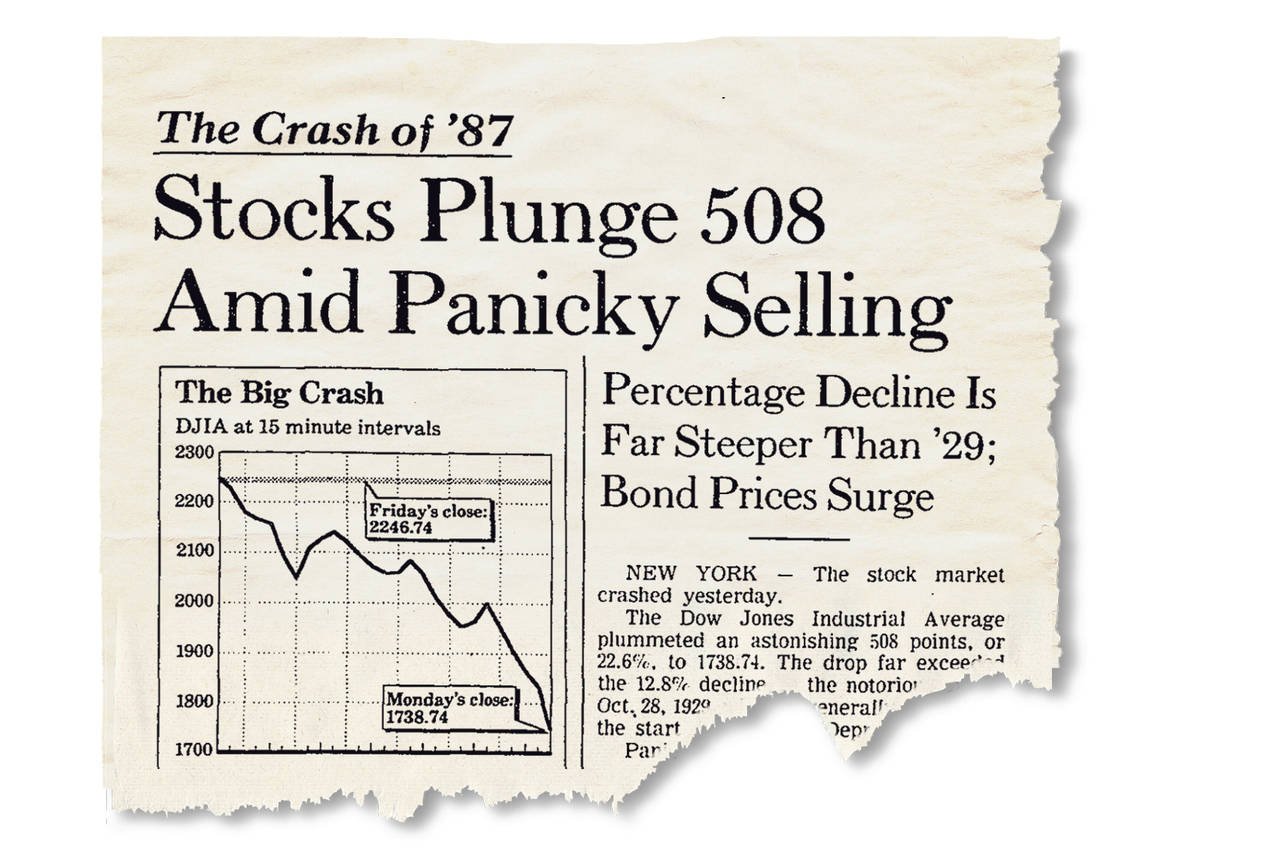
In my earlier years, I had a lot of fun with “False Profits?”. False Profits is just a little pun as in “false prophets”. I would point out forecasts that appeared in the financial media and then compare them to the “quite different” reality that followed. The goal was to illustrate one of the foundational truths of investing that runs contrary to the impressions we get from the investment industry: nobody knows what the future holds. Nobody. Period.
Driven by my analytical mind, I would collect and file predictions from experts, highly regarded money managers, acclaimed journalists, and researchers. My collection became quite literally a Gold mine of material. Here are a few examples:
The Dow Jones Industrial Average lost 554.26 points, which was a 7.18% decline. This drop was the index’s largest single-day loss at the time and was caused by the Asian currency crisis and other global financial concerns, leading to a day of trading later dubbed the “mini-crash.” Investors were looking to the best and brightest of Wall Street for guidance. In response, the next day , The Wall Street Journal ran an article on the front page of its “Money & Investing” section that opened with this summary:
“Even the optimists aren’t forecasting a quick recovery. And the pessimists say we are entering a bear market that could last for months.”
This was completely wrong. In fact, the selloff was already over. The market never went lower, and the Dow rose 30% over the next nine months!
On July 16, 1998, the Dow exceeded 9300 and the Nasdaq passed 2000, both new records. The Wall Street Journal gave this upbeat assessment:
“Investors who have been holding money out of the market, waiting to see whether Asia and a slowing US economy would hold back corporate performance, appear to have taken the recent favourable earnings news as a sign that the worst could be over, at least for now.”
Again, 100% wrong. That very day, a frightening two-month selloff began, taking the Dow down 20% and the Russell 2000 index of smaller companies down a shocking 33%!
False prophets continue to appear frequently. Whenever there are strong market movements in either direction, predictions —very often contradictory —come out in large numbers.
When it comes to investing, no one knows anything about the future with certainty. Even if experts expect things might go awry, they cannot predict how or when the economy, government, or markets will react, which could make the crisis worse or better. No one can accurately predict when and how far the markets will crash, when it will bottom, or how quickly it will recover.
We need to learn to ignore anyone who claims otherwise. At best, predictions are entertaining; at worst, they can cost you a great deal of money as you are drawn away from your long-term plan. At fundalytix, we don’t make predictions because doing so endorses the idea that investors can profit from the opinions of market professionals.
The way to deal with the uncertainty presented by the markets is not to look to the “experts” for their latest up-to-the-minute advice. Instead, develop a long-term plan that accounts for market uncertainty. Our consistent advice, regardless of market conditions, is to: (1) select a mix of stocks and bonds that balances your need for growth and fear of loss, (2) diversify adequately, (3) expect to do well over the next five years, not necessarily the next five months, and (4) Keep Calm And Carry On. Focus your time and energy on the things in life that truly matter.
Concepts of Momentum Investing have proven effective for decades, and in most cases, centuries. Our strategies employ some version of momentum and trend-following. These are fundamental market forces that have worked for as long as financial markets have existed. Momentum Investing isn’t just about generating returns; it’s also about reducing losses and managing risk. Losses cause investors to abandon their investment plan, usually at the worst possible moment. Also, we diversify our bets, because no one – not us at fundalytix, nor anyone else – knows with absolute confidence what will outperform in the future. By providing a smoother ride, investors are more likely to stay the course while sleeping better at night.
